



By Luiz Cláudio S Ferreira (DecoStop Nr 64)
3. Operational Implications and Practical Risks
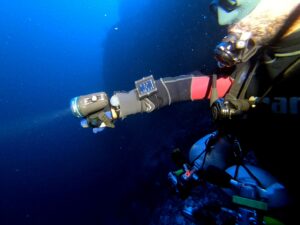
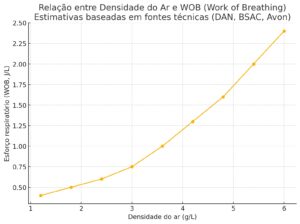
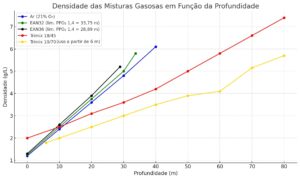
Density values above 6.2 g/L are considered critical in open circuit, and above 5.0 g/L in rebreathers. Breathing equipment must be sized to respond efficiently at depth, with regulators adjusted for optimal flow and minimum inspiratory resistance [Fig. 3] [Fig. 4].
Regarding the efficiency of ventilatory supply, the choice of regulator type directly impacts the total respiratory effort (WOB – Work of Breathing). High-performance balanced regulators maintain the WOB below ~2.0 J/L at 50 m and below ~2.5 J/L even at 100 m, according to tests conducted on ANSTI (Automated National Standards Testing Interface) benches. This makes them suitable for technical diving at depth, even with high respiratory density (sources: dansa.org; en.wikipedia.org; scubaboard.com; divelab.com).
On the other hand, unbalanced regulators, of older design or without internal compensation, tend to exhibit a significant increase in WOB from 30–50m, frequently exceeding the 3J/L limit established by the European standard EN250, and can reach values of 4–5J/L at 100m. This excess compromises effective ventilation and can precipitate the onset of hypercapnia in divers under moderate physical load. EN250 defines this limit under standardized conditions of 62.5L/min at 50m depth, as the maximum acceptable parameter for the certification of recreational and technical equipment (scubadiving.com; xray-mag.com; divernet.com).
In dives carried out at extreme depths, beyond 100 meters, the density of the breathed gas can quickly exceed physiological limits, even with the use of optimized Trimix mixtures. In these operations, in addition to density control, it becomes necessary to apply more conservative gradient factors (e.g., GF 20/85) in decompression models, such as the ZH-L16 with adjustments for bubbles. This is because hypercapnia and ventilatory effort increase CO₂ production and physiological load, requiring more gradual and well-planned ascent strategies. Furthermore, increased density can alter the subjective perception of effort and limit psychomotor performance, being a relevant factor in activities that require rapid decision-making. Advanced training should include simulation of ventilation under high density to prepare the diver for emergencies where the respiratory response may be limited by the density of the mixture itself.
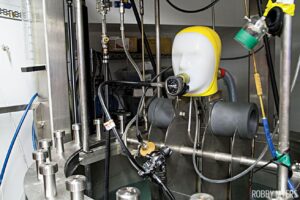
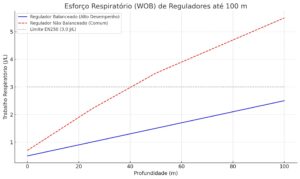
Fig. 4 (Fonte Excell Autor)
4. Technical Conclusion
Respiratory density cannot be dissociated from the physiological and operational planning of technical dives. Its impact on the ventilatory system requires attention equivalent to oxygen toxicity, nitrogen narcosis, and decompression profile. At greater depths, its interaction with decompression patterns becomes even more relevant, as it directly influences respiratory safety and the effective elimination of inert gases. Including this factor in risk matrices is indispensable for safe operations, reducing the chance of hypercapnia, ventilatory exhaustion, and critical failures in extreme environments. Mastering the concept of respiratory density, combined with the intelligent use of gas mixtures and adjusted decompression algorithms, is essential to safely expand the operational limits of technical scuba diving.
5. References
ANTHONY, T. G. Gas Density and Its Impact on Scuba Diving. ScubaTech Philippines, 2015. Available at: https://www.scubatechphilippines.com. Accessed on: June 27. 2025.
EUROPEAN COMMITTEE FOR STANDARDIZATION (CEN). EN250:2014 – Respiratory Equipment: Open Circuit Self-Contained Compressed Air Diving Apparatus – Requirements, Testing and Marking. Brussels: CEN, 2014.
DAN SOUTH AFRICA. Breathing Resistance in Diving Regulators: Field and Laboratory Analysis. South Africa: Divers Alert Network, 2021. Available at: https://www.dansa.org. Accessed on: 27 June. 2025.
DIVE LAB INC. ANSTI Breathing Simulator Test Reports – Regulatory Performance Data. Panama City, FL: Dive Lab, 2018–2024. Available at: https://www.divelab.com. Accessed on: 27 June. 2025.
MITCHELL, S. J.; DOOLETTE, D. J. Physiology and Medicine of Hyperbaric Oxygen Therapy. 2nd ed. Philadelphia: Saunders, 2015. Chapter: Physiological and Pathophysiological Responses to Hyperbaric Exposure.
NOAA – NATIONAL OCEANIC AND ATMOSPHERIC ADMINISTRATION. NOAA Diving Manual. 4th ed. Flagstaff: Best Publishing, 2002. Chapter on oxygen exposures and PPO₂ limits.
SCUBABOARD TECHNICAL FORUM. Regulator Testing: WOB Values and Field Experiences. ScubaBoard Forum, 2019–2024. Available at: https://www.scubaboard.com/community/threads/regulator-testing-wob-values.575655. Accessed on: June 27, 2025.
WIKIPEDIA CONTRIBUTORS. EN 250 – Scuba Regulator Testing Standards. Wikipedia, The Free Encyclopedia, 2024. Available at: https://en.wikipedia.org/wiki/EN_250. Accessed on: June 27, 2025.
X-RAY MAGAZINE. Regulator Performance and Testing Explained. X-Ray International Dive Magazine, ed. 92, 2020. Available at: https://www.xray-mag.com/content/regulator-performance-and-testing. Accessed on: June 27, 2025.
ANSTI Breathing Machine Test Data – Laboratories such as DiveLab (USA) and Apeks publish validated WOB tables for various models (DiveLab).
EN250 Standard – European standard for certification of self-contained underwater breathing apparatus (Wikipedia).
DAN South Africa and USA – Published works on respiratory effort physiology in technical regulators (DANSA.org).