


By Luiz Cláudio S Ferreira (DIVE Ops nr 23)

The evolution of technical difference has increased the depth, duration, and complexity of underwater operations. This advance has highlighted the importance of understanding physiological phenomena that occur simultaneously, often without immediate symptoms. Among these phenomena, the formation of silent microbubbles, variations in ventilatory workload, and the impact of operational failures on the diverse’s integrity during the return to the surface stand out. These three factors, when combined, can significantly alter the physiological margin predicted by depression models and constitute a critical axis in the analysis of incidents at depth.
The formation of silent microbubbles is a common event after prolonged exposure to high assumptions. They appear even when the diver meets theoretically correct profiles and remains initially subclinical. Their presence, however, changes tissue perfusion and can reduce the efficiency of insert gas elimination. The longer the bottom time, the higher the respiratory density, and the greater the local physical exercise, the greater the likelihood that these microbubbles will interfere with gas exchange mechanisms. In deep trimix or CCR dives, this change in perfusion is particularly relevant because small changes in the behavior of the fast-compartments can shift the gradient allowed by the model.
The ventilatory workload interacts directly with this scenario. At greater depths, the density of the sustained mixture increases significantly and raises the resistance to gas flow. The diver then requires more force to move air through the respiratory system and equipment. This additional effort increases carbon dioxide production and facilitates the accumulation of this gas, especially when the different faces active dislocation, current, cold, or the need to correct position. The physiology of carbon dioxide has an immediate impact on cognition, fine engine control, and the perception of effort. In addition, the increase in CO2 alters the vascular response and can increase the trend for growth of already present silence microbubbles.
When these physiological factors combine with operational failures, the risk is enhanced. Unlike accidents resulting from clear violations of procedure, severe incidents in technical having occurred within seeingly safe profiles, but in contexts where the diver was under high respiratory load and with silent microbubbles in the ascending phase. A slowly accelerated initial ascent, a need for additional handling, or a thermal disturbance can shift the system outside the physiological margin predicted by the depression model. Profiles designed based on static parameters do not necessarily capture the impact of current effort at depth.
Operationally, the technical diver must recognize that the ventilatory workload is not a constant variable and that its sudden increase anticipates the approach to the model limits. The presence of subclinical microbubbles reduces physiological tolerance to disorders. Therefore, decisions such as anticipating gas transitions, modulating the ascent rate, reducing unnecessary gaps, or temporarily disrupting activities that require greater CO2 production have a direct effect on maintaining physiological stability. In CCR (Corrected Cardiac Cardiac), adjustments to the setpoint and attention to the respiratory loop alley even more relevant. In open circuit therapy, ventilation control and respiratory density management are crucial to avoid hypercapnia.
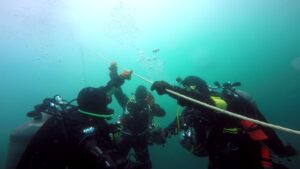
Post-dive incident analysis demonstrates that small changes in different behavior at depth can produce enhanced results during the ascent phase. These events illustrate that silent microbubbles, ventilatory effort, and operational failures are not independent factors. They influence each other and can displace the diverse out of the physiological safety zone without clear prior warning signs. An integrated understanding of these elements, combined with conservative planning and disciplined execution, contributions to more stable profiles aligned with the real conditions faced in the underwater environment.
This approach demonstrates that the success of technical diving does not depend solely on meeting mathematical parameters. The combination of physiology, behavior, and technique is crucial. The diver who understands how silent microbubbles interact with ventilatory load and how these variables are affected by operational decisions maintained a significant advantage in risk management at department.